
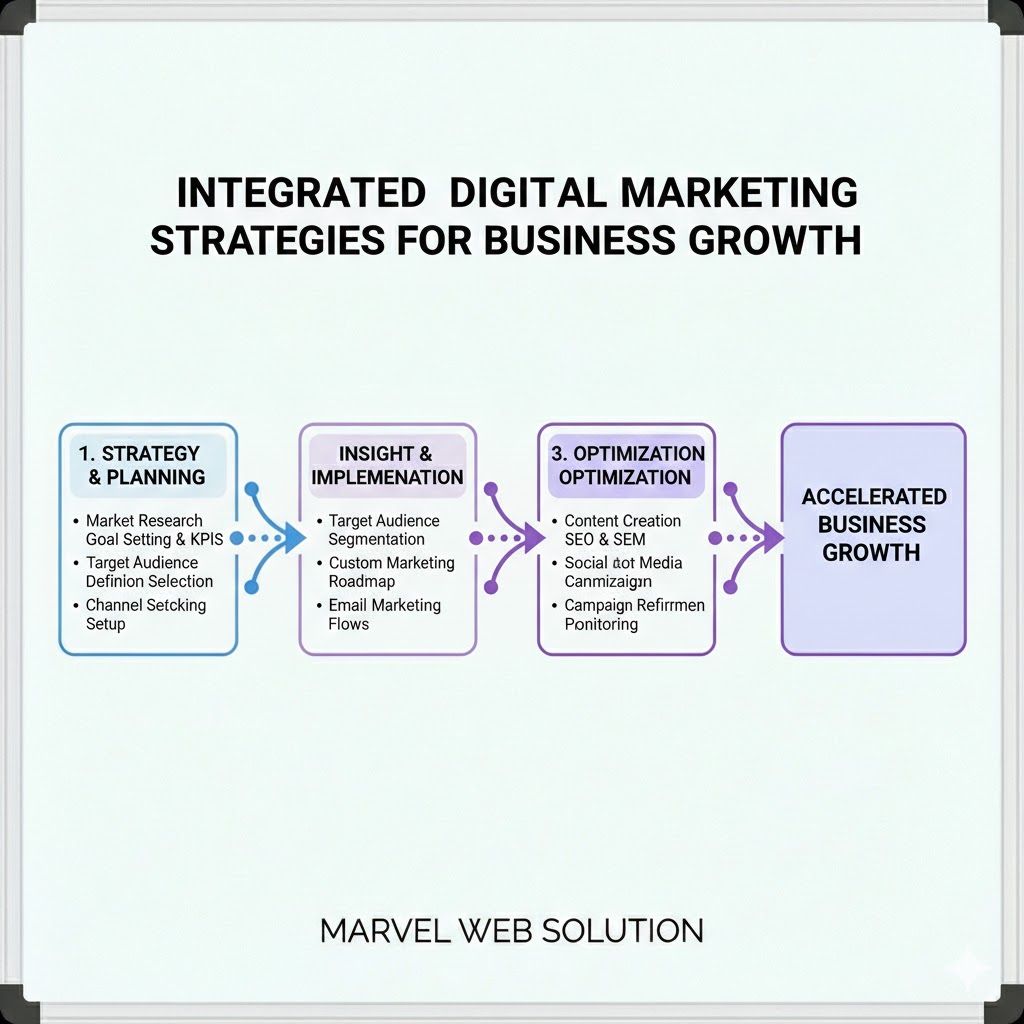
In an increasingly competitive digital landscape, businesses can no longer rely on isolated marketing tactics to achieve sustainable growth. Search engines, social media platforms, websites, email campaigns, and paid advertising channels are deeply interconnected. To succeed, brands must adopt integrated digital marketing strategies that align every channel toward common business goals.
An integrated approach ensures consistency, improves efficiency, and delivers stronger results by allowing different marketing channels to support and amplify one another. Instead of fragmented efforts, businesses gain a unified system that drives visibility, engagement, and conversions at every stage of the customer journey.
What Integrated Digital Marketing Really Means
Integrated digital marketing is the strategic coordination of all online marketing activities into one cohesive framework. It brings together SEO, content marketing, social media marketing, paid advertising, web development, analytics, and conversion optimization under a single strategy.
Rather than treating each channel as a standalone effort, integration ensures that messaging, branding, and objectives remain aligned. For example, content created for SEO can be repurposed for social media, while paid ads reinforce organic visibility and brand recall.
This alignment allows businesses to maximize return on investment while maintaining a consistent brand experience across platforms.
Why Businesses Need Integrated Strategies Today
Modern consumers interact with brands through multiple digital touchpoints before making decisions. A potential customer might discover a brand through a social media post, research it on Google, visit the website, and later convert through a retargeting ad.
If these touchpoints feel disconnected or inconsistent, trust erodes. Integrated digital marketing solves this problem by creating a seamless experience regardless of where users engage with the brand.
For businesses aiming to scale, integration reduces duplication of efforts, improves data accuracy, and enables better decision-making based on holistic insights rather than isolated metrics.
SEO as the Foundation of Long-Term Growth
Search engine optimization remains one of the most powerful components of an integrated digital strategy. SEO drives consistent, high-intent traffic and supports nearly every other marketing channel.
When SEO is integrated properly, keyword research informs content creation, website structure, and even paid advertising strategies. Optimized content improves organic visibility while also serving as valuable material for email campaigns and social media sharing.
By embedding SEO into the core digital strategy, businesses create a sustainable growth engine rather than relying solely on paid traffic.
Content Marketing That Supports Every Channel
Content acts as the connective tissue of integrated digital marketing. Blogs, landing pages, videos, guides, and case studies fuel SEO, social media, email marketing, and paid campaigns simultaneously.
An integrated strategy ensures content is created with clear objectives, target audiences, and distribution plans. Instead of producing content in isolation, businesses align topics with search demand, social trends, and customer pain points.
High-quality content builds authority, improves engagement, and supports conversion goals across the entire digital ecosystem.
Social Media Marketing for Visibility and Engagement
Social media plays a crucial role in amplifying content and strengthening brand presence. Within an integrated strategy, social platforms are used not just for posting updates, but for driving traffic, building communities, and supporting lead generation.
Content published on websites gains additional reach through social sharing, while social engagement signals help reinforce brand credibility. Paid social campaigns complement organic efforts by targeting specific audiences and accelerating visibility.
When aligned with SEO and content strategies, social media becomes a powerful growth multiplier rather than a standalone activity.
Paid Advertising as a Strategic Accelerator
Paid digital advertising delivers immediate visibility and supports faster growth when integrated properly. Search ads capture high-intent users, while display and social ads build awareness and support retargeting.
Integration ensures that paid campaigns align with organic messaging, landing page content, and conversion goals. Insights from paid ads also inform SEO and content strategies by revealing which keywords, messages, and offers perform best.
This data-driven alignment helps businesses scale efficiently without wasting ad budgets.
Website Optimization and Conversion Strategy
A website is the central hub of all digital marketing efforts. Integrated strategies focus heavily on website performance, user experience, and conversion optimization.
Traffic from SEO, social media, and ads must lead to fast-loading, well-structured pages that guide users toward desired actions. Clear messaging, intuitive navigation, and strong calls to action are essential for converting visitors into leads or customers.
By aligning website design with marketing objectives, businesses ensure that every channel contributes directly to measurable growth.
Data, Analytics, and Continuous Optimization
One of the biggest advantages of integrated digital marketing is access to unified data. Instead of analyzing channels separately, businesses gain a complete view of user behavior across platforms.
Analytics tools track how users move from one channel to another, where they convert, and where drop-offs occur. This insight enables continuous optimization of campaigns, content, and user journeys.
Data-driven decisions reduce guesswork and allow businesses to refine strategies based on real performance, leading to better outcomes over time.
Supporting Local, National, and Global Expansion
Integrated digital marketing strategies are highly adaptable, making them suitable for businesses at every growth stage. Local companies benefit from geo-targeted SEO and social campaigns, while national brands build authority through content and consistent messaging.
For businesses targeting international markets, integration ensures localized content, region-specific SEO, and culturally relevant campaigns work together seamlessly.
This flexibility allows businesses to scale without losing strategic focus or brand consistency.
Choosing the Right Digital Marketing Partner
Executing an integrated digital strategy requires expertise across multiple disciplines. Businesses often struggle to manage SEO, content, social media, ads, and analytics internally without a unified approach.
Working with an experienced agency like Marvel Web Solution helps businesses implement cohesive strategies aligned with their goals. With a structured process and cross-channel expertise, they ensure every marketing effort contributes to visibility, engagement, and growth.
A reliable partner also provides ongoing optimization, transparent reporting, and strategic guidance as digital trends evolve.
Long-Term Business Impact of Integration
Integrated digital marketing is not a short-term tactic; it is a long-term growth framework. Over time, aligned strategies strengthen brand authority, improve customer trust, and reduce reliance on any single channel.
Businesses benefit from more predictable lead generation, higher conversion rates, and stronger customer retention. As competition intensifies, integration becomes a key differentiator between brands that grow steadily and those that struggle to maintain momentum.
By adopting integrated digital marketing strategies and working with experienced partners such as Marvel Web Solution, businesses position themselves for consistent, scalable, and measurable growth in the digital age.
In a market driven by attention and trust, integration is no longer optional. It is the foundation of sustainable business success.